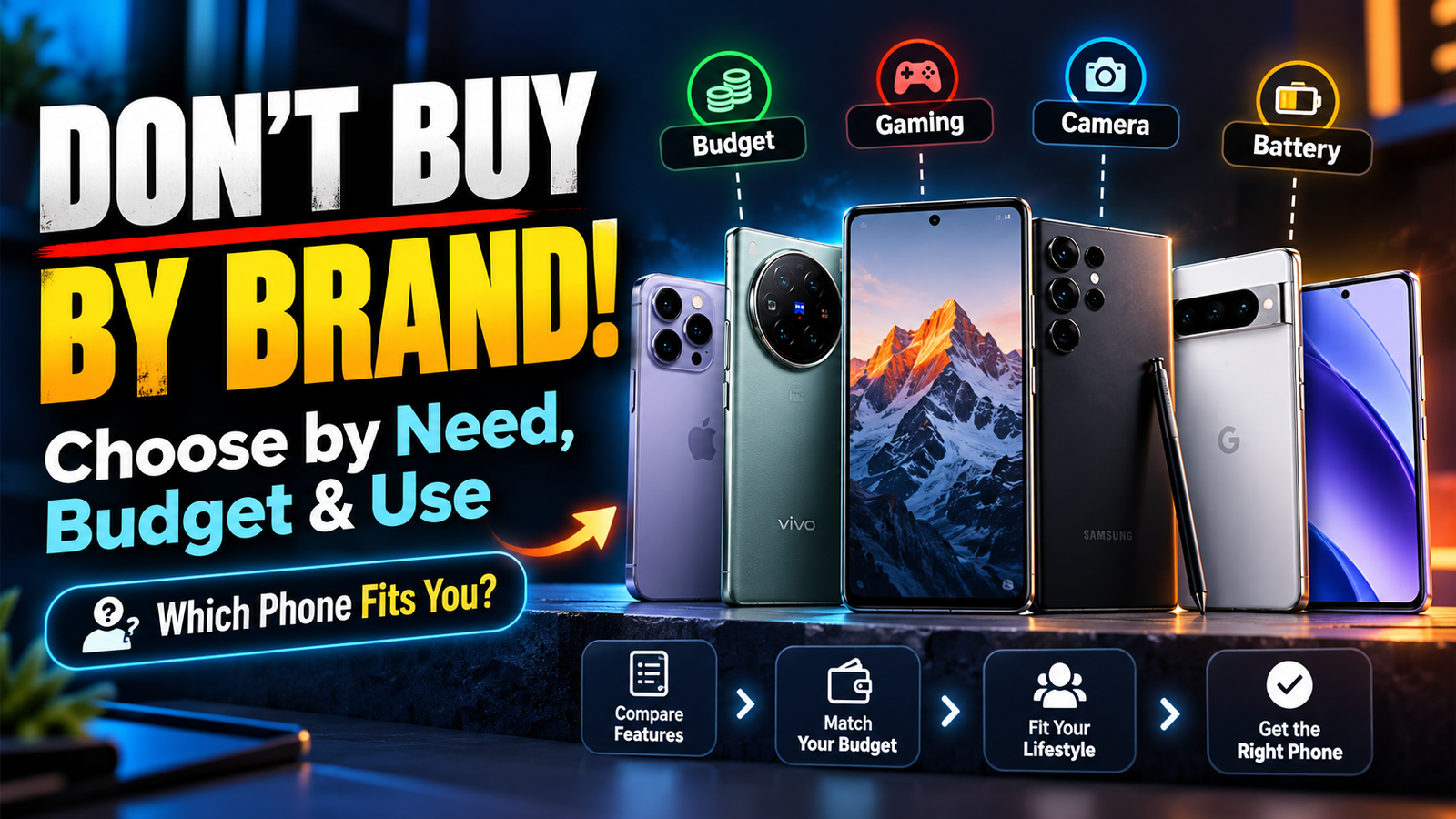
Buying a new smartphone has become more confusing than ever. Every brand launches multiple phones every year, advertisements highlight impressive numbers, social media is filled with recommendations, and online sales constantly encourage people to upgrade.
Because of this, many buyers make one basic mistake: they decide the brand first and think about their requirements later.
Someone may say, “I only want Samsung.” Another person may automatically search for an iPhone. A gamer may buy a camera-focused phone because it looks premium, while a casual user may spend much more than necessary on a high-performance processor that they will rarely use.
A better approach is much simpler.
Before choosing the phone, ask yourself four questions:
What is my budget?
How do I actually use my phone every day?
Which features are most important to me?
Which phone offers specifications that match those requirements?
The correct smartphone is not necessarily the most expensive model, the newest launch or the phone from the most popular brand. It is the phone that matches your usage with the fewest unnecessary compromises.
This guide explains how different types of users should choose a smartphone and which specifications deserve attention before spending money.
First Decide Your Budget, Not Your Brand
Budget should be the starting point of smartphone selection.
A person with a ₹20,000 budget and another person with a ₹70,000 budget are shopping in completely different categories. However, spending more money does not automatically mean that every aspect of the experience will improve equally.
A higher-priced phone may offer a stronger processor, better materials, improved camera processing, wireless charging or longer software support. But if your daily activity consists mainly of calling, messaging, browsing, UPI payments, social media and watching videos, you may not benefit enough from those additions to justify a significantly higher price.
Instead of stretching your budget just to buy a particular brand, create a realistic spending range.
For example, if you have decided to spend approximately ₹25,000, compare phones that offer the strongest combination of battery life, display quality, performance, cameras and software experience within that category.
Do not compare them emotionally based on logos.
Compare them based on what you will actually use.
Understand Your Primary Purpose
Different smartphones are designed with different priorities.
One device may focus heavily on performance. Another may concentrate on photography. One model may provide a very large battery, while another offers a slimmer and lighter body. Some manufacturers prioritise long-term software support, while others provide aggressive hardware specifications at a lower price.
That is why asking “Which is the best phone?” is usually not enough.
A better question is:
Which is the best phone for my usage?
A gamer, student, traveller, content creator, office employee and casual smartphone user can all receive different answers.
For Basic Everyday Users
If your daily activities include WhatsApp, Instagram, YouTube, calls, browsing, UPI payments, maps and occasional photography, you do not need flagship-level processing power.
Your priorities should instead be:
A reliable processor
Good battery life
At least a decent amount of RAM
Enough internal storage
A bright display
Good network support
Reliable software
Reasonable camera performance
Comfortable design
For a user like this, spending a huge amount purely for benchmark performance usually provides little practical benefit.
An Android phone with a modern mid-range processor and sufficient RAM can already deliver a smooth experience for common applications.
Storage is particularly important. Someone who rarely records videos may manage comfortably with 128GB, while a person who saves many photos, videos and large apps should seriously consider 256GB.
Do not assume that more RAM automatically makes a phone dramatically faster. Processor performance, storage speed, software optimisation and thermal management also contribute to the overall experience.
For Users Who Need Maximum Battery Life
Battery-focused users should not select a smartphone merely by checking whether it says “5000mAh” on the specification sheet.
Battery life depends on several factors:
Battery capacity
Processor efficiency
Display size
Display resolution
Refresh rate
Software optimisation
Network usage
Gaming
Camera usage
Background applications
A larger battery is still useful, especially for travellers, delivery workers, students attending long classes or anyone who spends most of the day away from a charger.
A good current example of a battery-focused smartphone is the REDMI Note 17 5G.
Xiaomi lists an 8000mAh battery, 45W charging, a 120Hz AMOLED display and Snapdragon 4 Gen 4 processor for the REDMI Note 17 5G. This combination makes the device particularly relevant to people who value long battery endurance more than flagship-level processing power. Xiaomi
Who should consider the REDMI Note 17 5G?
It can make sense for:
Students
People who travel frequently
Heavy YouTube and social media users
Users who want a large display
People who dislike charging their phone frequently
Casual users who value battery life over extreme gaming performance
However, a large battery alone does not automatically make a phone the correct choice for everyone. Someone who wants a compact and lightweight phone may prefer sacrificing some battery capacity for better ergonomics.
That is exactly why requirements should come before specifications.
For Gaming and Performance Users
Gaming changes the priorities completely.
If you regularly play demanding mobile games, edit videos on your phone or use performance-heavy applications, the processor becomes much more important.
Gaming users should examine:
CPU performance
GPU performance
Cooling system
Display refresh rate
Touch response
RAM
Storage speed
Battery capacity
Charging speed
Sustained performance
Do not judge gaming performance using RAM alone.
A phone advertised with 12GB or 16GB RAM can still perform worse than another model with less RAM if its processor and cooling system are weaker.
One example for performance-oriented users is the iQOO Z11x 5G.
iQOO lists the Z11x with a MediaTek Dimensity 7400-Turbo processor and a large 7200mAh battery. The company also highlights durability features and its latest software experience. iQOO Official Store
For users seeking substantially higher gaming performance, iQOO’s current lineup also includes models such as the Neo 10 with Snapdragon 8s Gen 4 and the higher-end iQOO 15 series. iQOO Official Store
Who should consider a performance-focused phone?
Mobile gamers
People editing videos regularly
Users running demanding applications
Heavy multitaskers
People who plan to keep the phone for several years and want stronger performance headroom
For gaming, also pay attention to sustained performance rather than only benchmark scores. A phone may achieve an excellent benchmark result for a short test but reduce performance after becoming hot.
Real-world stability matters more than a single score.
For Users Who Want a Balanced Smartphone
Most people probably fall into this category.
They want:
A good display
Reliable cameras
Good battery life
Smooth everyday performance
Good build quality
Long-term software updates
Security features
Reliable service support
They may occasionally play games but are not hardcore gamers. They may take many pictures but do not need professional camera controls.
For this type of user, phones such as the Samsung Galaxy A57 5G can make more sense than choosing a gaming-focused device purely because it has a stronger processor.
Samsung’s Galaxy A57 5G offers a 120Hz Super AMOLED Plus display, a 50MP main camera with optical image stabilisation, a 5000mAh battery and 5G connectivity. Samsung also lists software security support through March 2032 for the model. Samsung
Samsung says the A57 series is eligible for up to six generations of Android and One UI upgrades along with long-term security support. Samsung Global Newsroom
Who should consider the Galaxy A57 5G?
Users wanting a balanced phone
People who care about long-term software support
Office users
Students
Social media users
People who want dependable everyday photography
Users already using other Samsung devices
Notice that this recommendation is not based simply on the Samsung logo.
It is based on the requirements.
If gaming is your number-one priority, another device may offer more appropriate hardware. If camera processing and software experience are more important, another option may again be better.
For Camera-Focused Android Users
A camera buyer should never choose a smartphone simply because the advertisement shows a huge megapixel number.
A 200MP camera is not automatically better than a 50MP camera.
Smartphone photography depends on much more:
Sensor quality
Sensor size
Lens quality
Optical image stabilisation
Autofocus
HDR processing
Skin-tone processing
Low-light performance
Video stabilisation
Image processing software
Ultrawide quality
Telephoto hardware
A phone with excellent computational photography may deliver better results than another phone advertising a much higher resolution sensor.
For people who prioritise photography and a clean Android experience, the Google Pixel 10a is one current option worth understanding.
Google lists a 48MP wide camera and 13MP ultrawide camera on the Pixel 10a, along with optical and electronic stabilisation on the main camera. It also provides features such as Night Sight, Macro Focus, Portrait Mode, Face Unblur and other computational photography tools. Google Store
The Pixel 10a also includes a 120Hz-capable pOLED display, 8GB RAM, 256GB storage and Google’s Tensor G4 processor. Google Store
Who should consider the Pixel 10a?
Users who prioritise photography
People who prefer Google’s Android experience
Users who want AI-assisted photo features
People wanting long-term software-focused ownership
Casual creators
Users who prefer software experience over chasing benchmark numbers
For buyers with a larger budget, the Google Pixel 10 provides additional camera hardware, including a telephoto camera, along with Google’s Tensor G5 platform. Google Store
Again, that does not automatically make it the right phone for a gamer. Camera-focused phones and gaming-focused phones solve different problems.
For People Who Specifically Want iOS
Some buyers genuinely require an iPhone because they already use Apple products, prefer iOS, create content using Apple’s workflow or simply want to remain inside the Apple ecosystem.
In that situation, choosing an iPhone is based on a requirement rather than brand obsession.
For example, the iPhone 17e uses Apple’s A19 chip, includes 256GB starting storage, a 6.1-inch OLED Super Retina XDR display and a 48MP Fusion camera system. Apple
Apple also supports 4K Dolby Vision video recording on the device. Apple
Who should consider the iPhone 17e?
Existing iOS users
People using Mac or other Apple products
Users who prefer Apple’s software ecosystem
People who regularly shoot mobile video
Users specifically looking for long-term iPhone ownership without moving to Apple’s highest-priced models
But someone buying an iPhone only because friends use one should still reconsider.
Ask what you are receiving for your budget and whether you actually use the ecosystem advantages.
If your main goal is a giant battery, high-refresh gaming hardware or aggressive specifications for the price, an Android alternative may fit you better.
Content Creators Should Prioritise Different Features
If you create Instagram Reels, YouTube Shorts or longer videos using your smartphone, camera performance matters, but there are other considerations too.
Look for:
Reliable autofocus
Good skin tones
Stabilised video
Strong microphone quality
Good front camera video
Large storage capacity
Fast file transfer
Battery life
Consistent performance while recording
A phone that takes impressive still photos is not automatically the best video phone.
Likewise, 8K recording should not be the deciding factor for most creators. Good-quality 4K recording with reliable autofocus, stabilisation and consistent exposure is often more useful in practical content creation.
Storage is also extremely important for creators.
A few high-resolution videos can consume storage quickly. A content creator choosing between a small storage version and a 256GB or higher version should consider long-term usage rather than only the initial purchase price.
Students Should Avoid Overspending
Students frequently use their phones for:
Online classes
PDF files
Research
Messaging
Video calls
YouTube
Social media
Photography
Light gaming
For these requirements, a capable mid-range smartphone is generally enough.
Students should prioritise good battery life, sufficient storage, reliable performance and software support.
Spending flagship-level money solely because a device is popular on social media is unnecessary when a less expensive phone already meets every requirement.
The money saved could be more useful for a laptop, tablet, accessories, education or simply future expenses.
Do Not Choose a Phone by Megapixels Alone
Camera marketing is one of the easiest places to make a buying mistake.
You might see:
50MP
108MP
200MP
and assume that the largest number must produce the best camera.
That is incorrect.
Megapixels mainly describe resolution.
Image quality also depends on sensor characteristics, optics, image processing, dynamic range, stabilisation and many other factors.
When comparing cameras, look at actual camera capabilities rather than only the headline resolution.
For videos, check whether the camera supports optical stabilisation, what resolutions and frame rates are available and whether the phone maintains reliable focus.
Do Not Buy a Phone Only Because It Has More RAM
RAM is important for keeping apps available in memory and supporting multitasking, but it should not be considered in isolation.
A phone with 12GB RAM and a weak processor is not automatically faster than one with 8GB RAM and a much stronger processor.
Software optimisation also matters.
For regular usage, sufficient RAM combined with a modern processor is more important than chasing the largest possible RAM figure.
Also distinguish between physical RAM and software-based memory expansion. Virtual or extended RAM uses internal storage and should not be treated as identical to physical RAM.
Display Quality Matters More Than You Think
You probably look at your smartphone display for several hours every day.
That makes display quality one of the most important specifications.
Check:
OLED or LCD technology
Brightness
Resolution
Refresh rate
Outdoor visibility
HDR support
Colour quality
Screen size
Protection
A 120Hz display can make scrolling and animations feel smoother, but high refresh rate alone does not guarantee an excellent screen.
Brightness is especially important if you frequently use your phone outdoors.
Meanwhile, people who consume movies and videos may prefer a large OLED display, while users who value one-handed operation may intentionally choose a smaller screen.
Consider Software Updates Before Buying
Many buyers pay attention to hardware and completely ignore software support.
This becomes important if you plan to use the phone for three, four or five years.
Longer software support can provide:
New Android or iOS versions
Security patches
Compatibility with newer applications
New features
Better long-term usability
This is one reason phones such as Samsung’s recent Galaxy A series and Google’s Pixel devices may appeal to buyers prioritising longer ownership rather than changing phones every year. Samsung has committed the Galaxy A57 generation to extended OS and security support, while Google’s Pixel line also emphasises long-term software support. Samsung Global Newsroom
Storage Can Be More Important Than Extra RAM
Before purchasing, think about how much storage you currently use.
If your existing 128GB phone is already almost full, purchasing another 128GB model probably does not make sense.
Users who store:
4K videos
Offline movies
Large games
RAW photos
Downloaded files
WhatsApp media
Video editing projects
should seriously consider larger storage options.
Remember that the advertised storage capacity is not completely available to users because the operating system and pre-installed software use part of it.
Do Not Ignore Build Quality and Water Resistance
Specifications are useless if the device does not suit your lifestyle.
Someone working outdoors may care more about durability than having the thinnest possible phone.
Check the official IP rating when water and dust protection matter.
For example, Samsung lists IP68 water and dust resistance on the Galaxy A57 5G. Samsung Global Newsroom
However, an IP rating should never be treated as permission to intentionally expose the phone to water. Water resistance can also change over time with normal wear.
Use these ratings as additional protection, not as a reason to take unnecessary risks with an expensive device.
Charging Speed Is Useful, but Battery Health Also Matters
Fast charging can be extremely convenient.
If you frequently leave home after only a few minutes of charging, higher charging speeds may matter greatly to you.
For someone who charges overnight and easily reaches the end of each day, extreme charging speed may be far less important.
Again, requirements determine value.
Do not automatically select a phone because one number on the specification sheet is bigger.
Network and Connectivity Should Not Be Forgotten
Before buying a phone, especially an imported device, check whether it properly supports the network bands used in your region.
For most Indian buyers purchasing officially sold smartphones, this is usually straightforward, but connectivity still deserves attention.
Useful features can include:
5G
Dual SIM
eSIM
Wi-Fi standards
Bluetooth
NFC
GPS and NavIC support
USB transfer speed
Do not pay extra for connectivity features you will never use, but do not accidentally miss something important to your workflow either.
A Simple Way to Decide Which Phone You Actually Need
Instead of searching for “best smartphone”, create your own priority list.
For example:
User A
Budget: around ₹25,000
Priority: battery
Secondary priority: display
Gaming: light
Camera: average usage
In this case, a battery-focused model such as the REDMI Note 17 5G or another comparable device may deserve more attention than a camera-focused phone.
User B
Priority: gaming
Battery: important
Camera: secondary
This user should look toward performance-focused phones and prioritise processor, cooling and sustained gaming performance.
User C
Priority: camera
Gaming: almost never
Software experience: important
This person could reasonably prefer something like a Pixel.
User D
Priority: balanced usage
Software support: important
Camera: important
Gaming: occasional
A balanced device such as Samsung’s Galaxy A57 5G could fit this profile.
User E
Already uses Mac and other Apple products
Priority: video, software ecosystem and long-term iOS usage
This buyer may prefer an iPhone such as the iPhone 17e or another model according to budget.
None of these users has the same ideal phone.
That is the main point.
Final Smartphone Buying Checklist
Before pressing the buy button, ask yourself:
What is the maximum amount I comfortably want to spend?
What applications do I use most?
Do I actually play demanding games?
How important is the camera?
Do I record videos regularly?
How many hours of battery life do I need?
Do I prefer a large or compact screen?
How much storage will I need after two or three years?
How long do I plan to keep the phone?
How important are software updates?
Do I need water resistance?
Do I need NFC, eSIM or other connectivity features?
Is the phone comfortable to hold?
Does the model have reliable service support in my location?
If you answer these questions first, choosing the phone becomes much easier.
Conclusion: Buy for Your Requirements, Not for the Logo
There is no single smartphone that is perfect for everyone.
The REDMI Note 17 5G may make sense for someone prioritising battery endurance. An iQOO model may be more suitable for a performance-focused buyer. The Samsung Galaxy A57 5G can appeal to users seeking a balanced experience and long-term support. The Pixel 10a may fit a photography-focused Android user, while the iPhone 17e can make sense for someone who specifically values iOS and Apple’s ecosystem.
The important part is not the brand name written on the back of the phone.
The important part is whether the phone solves your requirements.
Start with your budget.
Then identify your purpose.
Decide which specifications actually matter for that purpose.
Compare phones objectively.
Finally, buy the model that matches those requirements most closely.
A smartphone is something you may use for several hours every day and keep for multiple years. Choosing it based on your own needs rather than advertisements, trends or brand loyalty can help you spend more wisely and end up with a device that genuinely suits your lifestyle.
Suggested SEO title:
How to Choose the Right Smartphone for Your Needs in 2026: Complete Buying Guide
Meta description:
Learn how to choose the right smartphone based on your budget, daily usage, battery, camera, gaming performance, display, storage and software support instead of buying only by brand name.
SEO keywords: smartphone buying guide 2026, how to choose a smartphone, best phone for my requirements, phone specifications explained, smartphone buying tips, gaming phone buying guide, camera phone buying guide, battery phone guide, Android phone buying guide, mobile buying guide India 2026
Suggested categories: Smartphones, Mobile Buying Guide, Technology, Android, Consumer Tech